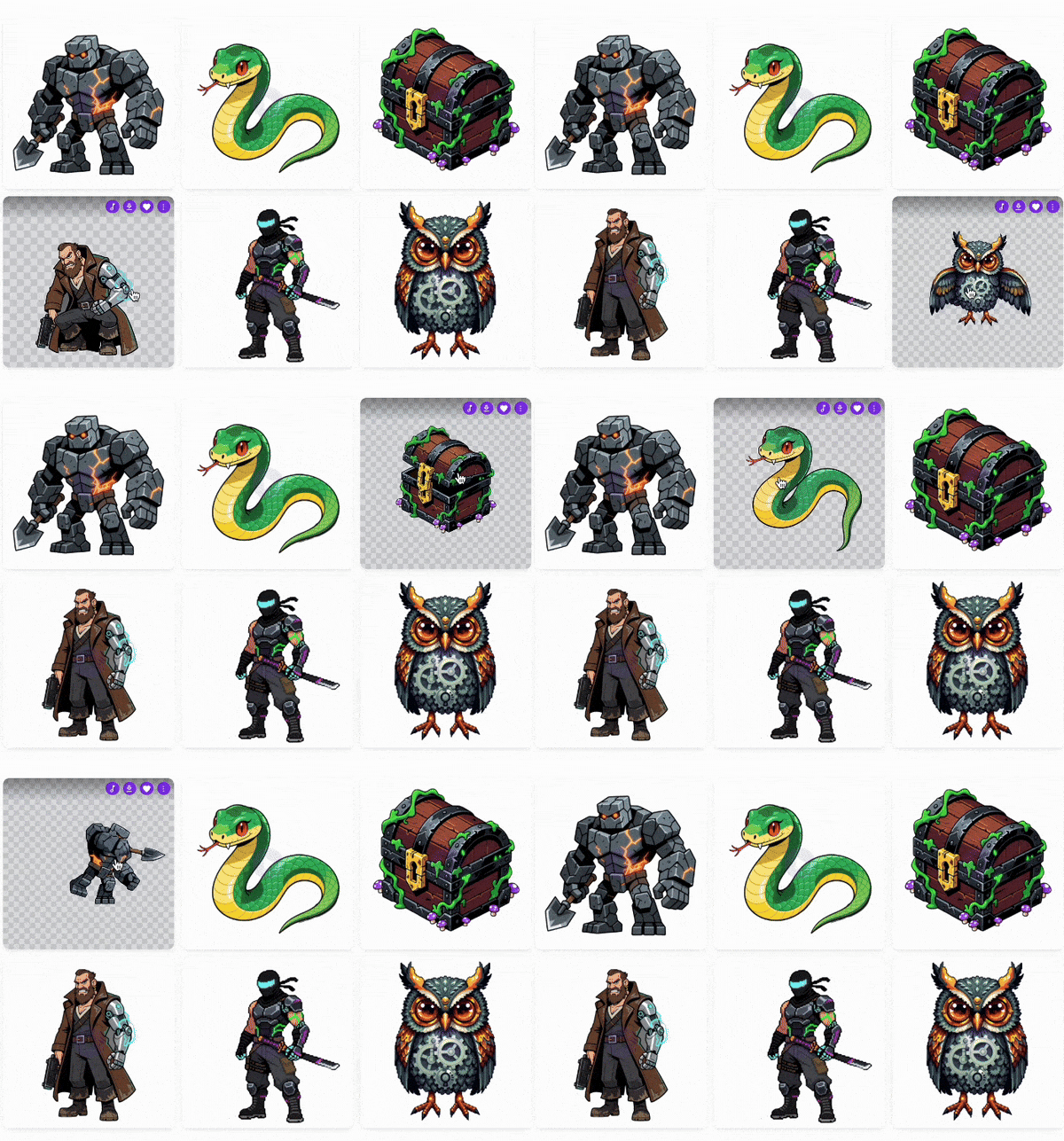
From Text to Game: Crafting Consistent AI-Generated Assets
The landscape of game development is undergoing a dramatic transformation, driven by the accelerating capabilities of artificial intelligence. What was once a futuristic concept is now a practical, indispensable tool for developers looking to streamline their workflows and unlock new creative possibilities. At the heart of this revolution is the ability to create high-quality AI generated game assets 10x faster, and crucially, to maintain unparalleled consistency across an entire game's visual identity.
Game development is famously asset-heavy. Every character, object, environment, and animation requires meticulous design and creation. This process can be incredibly time-consuming and expensive, often leading to bottlenecks and compromising a project's scope or release timeline. AI offers a powerful antidote, not by replacing skilled artists, but by acting as a supercharged assistant, automating the repetitive, generating rapid prototypes, and allowing human creativity to focus on refinement and innovation. The biggest challenge has always been ensuring that these rapidly generated assets adhere to a unified style – a challenge AI is now elegantly solving.
The Power of AI in Accelerating Game Asset Creation
Imagine being able to generate a library of unique game-ready assets in a fraction of the time it would traditionally take. This isn't a pipe dream; it's the reality offered by advanced AI tools. From intricate pixel art sprites to complex 3D models, AI is reshaping how developers approach asset pipelines. The efficiency gains are truly staggering:
- Rapid Prototyping: Instantly visualize concepts by turning simple text prompts or rough sketches into usable 3D models or pixel art scenes. This drastically shortens the ideation phase.
- Automated Repetitive Tasks: Generating multiple variations of an asset, creating sprite sheets for character animations, or producing directional rotations for top-down games are tasks that AI excels at, freeing up artists for more creative endeavors.
- Scaling Production: For games requiring a vast number of unique assets – think open-world environments or diverse item inventories – AI makes it feasible to populate these worlds without an impossibly large art team.
- Empowering Solo Developers & Indies: AI levels the playing field, giving smaller teams access to production capabilities previously reserved for large studios.
This paradigm shift means that AI in game development is supercharging asset creation, not replacing artists. It's about augmenting human talent with machine efficiency.
Achieving Visual Harmony: Consistency in AI-Generated Assets
One of the paramount concerns when integrating AI into any creative workflow is maintaining a cohesive aesthetic. A game's visual style is integral to its identity and immersion. Historically, generating a vast array of assets while ensuring they all "belong" together has been a manual, painstaking process. Modern AI tools are specifically engineered to address this, delivering remarkable consistency across all your ai generated game assets.
For 2D Pixel Art and Sprites:
- Style Adaptation: Leading AI generators can "learn" from your existing artwork. By uploading a reference sprite or concept image, the AI adapts its output to match your game's unique pixel density, color palette, and overall artistic style. This ensures that new characters, accessories, or environmental elements seamlessly integrate with your established visual language.
- Perfect Rotations: For isometric or top-down games, consistent character and object rotations (e.g., 4 or 8 directional views) are non-negotiable. AI tools can generate these complex sprite rotations with a single click, maintaining precise perspective and style across all angles, turning concept art into game-ready sprites effortlessly.
- Contextual Understanding: Advanced AI models can "see and understand" your original image while making edits. This means if you're changing a character's clothes, adding an accessory, or modifying an environment, the AI preserves the underlying style, ensuring the new elements feel native to the original piece.
For 3D Models and Environments:
- Parametric Generation with Style Presets: Tools like Sloyd AI offer parametric generation where you define assets (weapons, furniture, architecture) using sliders and inputs. Crucially, these tools often include style presets (e.g., "Low Poly," "Fantasy RPG") that automatically apply consistent polygon counts, texture resolutions, and stylistic treatments. This ensures that even highly customizable assets adhere to your game's intended look and performance requirements.
- Reference-Guided Generative AI: When using Text-to-3D or Image-to-3D, the quality of your prompt engineering and reference images directly influences consistency. By feeding the AI clear stylistic descriptions (e.g., "glowing arcane crystal, stylized, hand-painted textures") or uploading a consistent set of concept art, the AI generates models that align with your vision.
- Optimized & Game-Ready Output: Many AI platforms generate models that are already optimized for game engines, with clean meshes, appropriate polygon counts, and PBR textures. Features like LOD (Level of Detail) sliders allow developers to control asset complexity for various distances, maintaining both visual fidelity and performance consistency across the game world.
Practical Workflows: From Concept to Game-Ready Assets
Integrating AI into your asset creation pipeline can follow several practical paths, catering to different needs and asset types:
- Text-to-Animation & Environment:
- Pixel Art Characters: Describe character actions like "knight walking north," "wizard casting fire spell," or "rogue attacking left" to instantly generate animated sprite sheets.
- Animated Scenes: Bring entire environments to life with text prompts, creating dynamic backgrounds, storytelling sequences, or detailed atmospheric scenes for both top-down and side-scrolling games.
- Image-to-Asset Refinement:
- Concept Art to Sprites: Upload your initial character concept art and, optionally, a reference sprite, to generate a full set of consistent, game-ready directional views for pixel art.
- 2D to 3D Base Mesh: Turn a 2D sketch or reference image into a foundational 3D model, providing a strong starting point for further sculpting and detailing in traditional 3D software.
- Parametric and Generative 3D Modeling:
- Core Gameplay Props: Use parametric generators for precise assets like weapons, furniture, or architectural elements, adjusting details with intuitive sliders while maintaining optimization and style.
- Organic & Unique Elements: For items like strange alien plants, fantasy creatures, or unique background props, leverage Text-to-3D or Image-to-3D to rapidly ideate and generate base meshes that can then be refined.
- World Building Components:
- Maps, Tilesets & Textures: Generate comprehensive maps, modular tilesets, and texture assets from text descriptions, significantly speeding up environmental design for diverse game genres.
Integrating AI into Your Development Pipeline
The most effective use of AI in game development isn't as a magic button for finished assets, but as a powerful co-pilot within a hybrid workflow. Think of AI as providing 80% of the solution, allowing your artists to focus their expertise on the crucial final 20% of creative polish, optimization, and unique artistic flourishes.
A practical AI workflow might look like this:
- Ideation & Rapid Prototyping: Use generative AI (Text-to-3D/Image-to-3D, text-to-pixel-art) to quickly create numerous variations of a concept. Need a magical crystal? Prompt a few dozen variations and pick your favorite base.
- Selection & AI-Powered Refinement: Choose the asset closest to your vision. Leverage AI tools for style matching, generating rotations, or adding animations, ensuring it conforms to your game's aesthetic. Select style presets (e.g., "Low Poly" or "Fantasy RPG") to automatically apply consistent game-ready parameters.
- Human Artistic Polish: Export the AI-generated base asset into traditional editing software (e.g., Photoshop, Blender, Substance Painter). Here, human artists can add unique details, hand-paint textures, make intricate adjustments, or inject specific character that AI alone might miss. This is where the true artistic signature is applied.
- Optimization & Integration: Ensure the asset meets performance standards (e.g., using LOD sliders for 3D models, optimizing sprite sheet sizes). Finally, integrate the game-ready asset into your engine (Unity, Unreal, Godot, etc.).
By embracing this hybrid approach, developers can harness the immense speed and consistency benefits of AI while retaining absolute creative control and injecting the unique soul that only human artistry can provide.
Conclusion
The era of ai generated game assets has arrived, fundamentally altering the landscape of game development. From accelerating the creation of detailed pixel art characters and environments to rapidly producing optimized 3D models, AI is proving to be an invaluable asset. Its true power lies not just in speed, but in its ability to maintain a consistent visual style across diverse assets, a critical factor for any immersive game world. By integrating these intelligent tools into a smart, hybrid workflow, developers are now empowered to build richer, more detailed, and visually cohesive games faster and more efficiently than ever before, truly transforming text prompts and concept art into living, breathing game experiences.