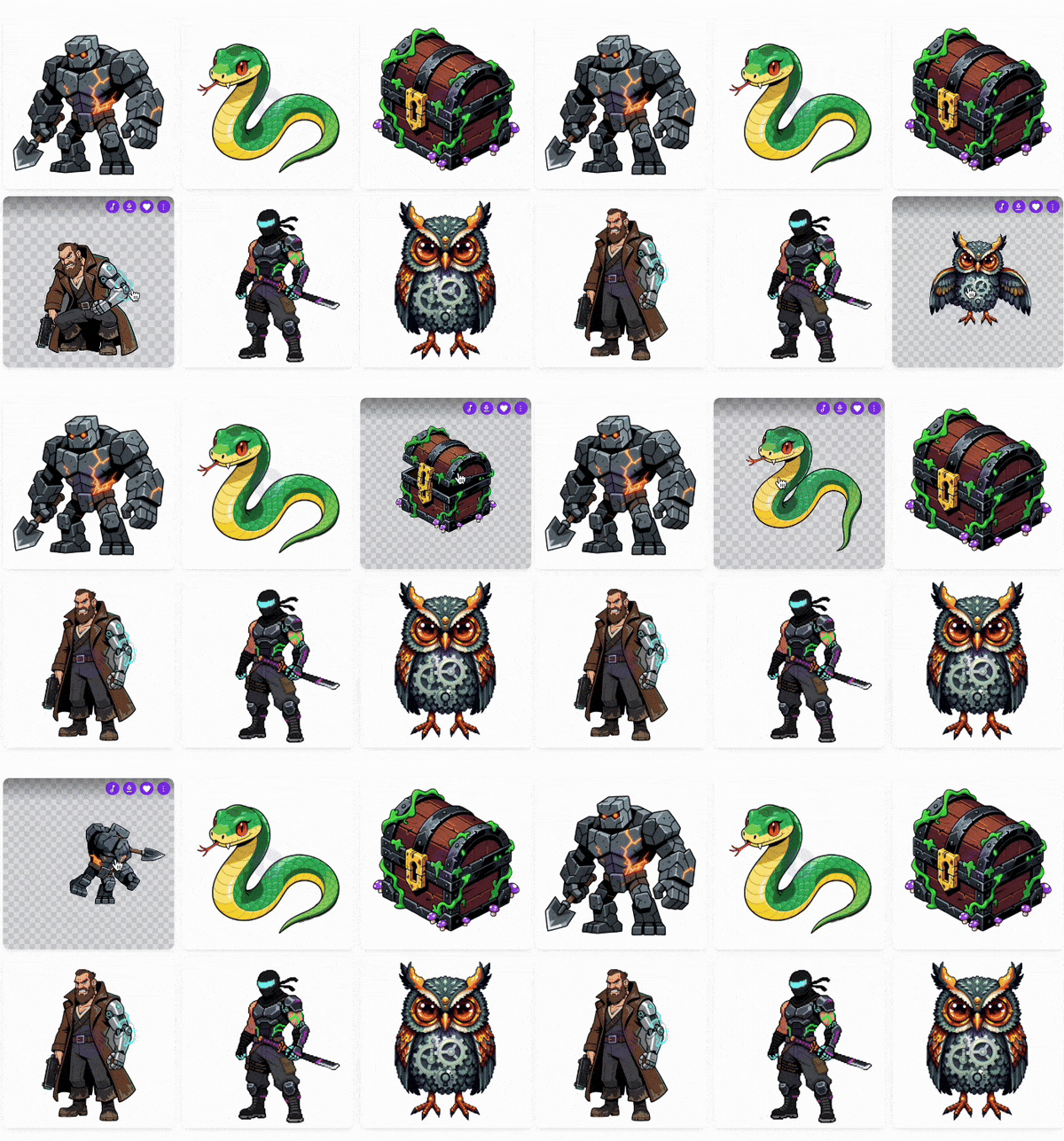
The Dawn of Accelerated Asset Creation: How AI Transforms Game Development
In the fast-paced world of game development, efficiency is paramount. Artists and developers are constantly seeking ways to streamline workflows, reduce production cycles, and unleash creativity without being bogged down by repetitive tasks. Enter artificial intelligence – a powerful ally that is radically transforming how we create game assets. Far from being a futuristic concept, AI is now a practical, indispensable tool, enabling developers to create game assets 10x faster than traditional methods, whether you're crafting intricate pixel art worlds or detailed 3D environments.
The short answer to whether AI can create game assets is a resounding YES. It's not about replacing the unparalleled skill and vision of human artists, but rather about supercharging their capabilities. AI acts as a sophisticated assistant, tackling the initial heavy lifting and tedious iterations, thereby freeing up artists to focus on the nuanced customization, optimization, and creative polish that truly define a game's unique aesthetic. This paradigm shift means less time on grunt work and more time innovating.
Beyond the Hype: AI as a Practical Workflow Enhancer
Integrating AI into your game development pipeline isn't about finding a magic "one-click" solution for every asset. Instead, it's about leveraging a robust assistant that gets you 80% of the way there in mere seconds. This hybrid approach allows for rapid prototyping, concept validation, and the swift generation of base meshes or sprites, providing artists with a strong foundation to build upon. By handling the initial generation, AI significantly shortens the production timeline, allowing for more iterations and experimentation.
AI's strength lies in its ability to process vast amounts of data and generate variations based on specific parameters or prompts. This leads to unprecedented speed in creating diverse sets of assets that maintain a consistent style, a critical factor for a cohesive game world. For a deeper dive into AI's broader role in game development, check out our article: AI in Game Dev: Supercharging Asset Creation, Not Replacing Artists.
AI-Powered Pixel Art: Bringing Retro Visions to Life 10x Faster
Pixel art, with its charming retro aesthetic, often involves meticulous, frame-by-frame creation. AI is revolutionizing this intricate art form, allowing developers to generate pixel art assets with astonishing speed and consistency. Imagine a tool that understands your vision and translates it into game-ready sprites and environments almost instantly.
- Dynamic Character Generation and Animation: Craft unique pixel art characters from simple text prompts. Beyond static sprites, AI tools can generate complex animations like walking, running, attacking, and custom actions. Some advanced systems even offer skeleton-based controls or automatic character creators, delivering full sprite sheets ready for integration into your game. This eliminates countless hours of manual animation work.
- Vibrant Scene and Environment Creation: Bring entire game worlds to life by describing what you envision. AI can generate detailed pixel art scenes and environments from text descriptions, perfect for creating atmospheric backgrounds, intricate maps, tilesets, and storytelling sequences. This capability accelerates world-building, providing developers with a vast library of unique backdrops.
- Perfect Sprite Rotations with a Single Click: One of the most tedious aspects of pixel art, especially for isometric or top-down games, is creating consistent directional views for characters and objects. AI tools can generate 4 or 8-directional rotations with a single click, ensuring pixel-perfect consistency across all angles and saving immense manual effort.
- Style Consistency and Adaptation: Maintaining a consistent visual style across hundreds or thousands of assets is a major challenge. AI generators excel here. By providing reference images, these tools can adapt to your game's existing aesthetic, generating new characters, objects, or environmental elements that seamlessly match your vision. What sets some tools apart is their ability to "see and understand" your original image while making edits, ensuring perfect style matching when changing clothes, adding accessories, or modifying environments without losing the base artistic integrity.
These capabilities mean that creating consistent AI-generated assets is no longer a dream but a practical reality for pixel art games, dramatically cutting down production time for indie and AAA studios alike.
Revolutionizing 3D Asset Creation with AI: From Concept to Game-Ready Props
The realm of 3D game assets also benefits immensely from AI-driven workflows. From highly optimized props to fantastical creatures, AI is streamlining the entire production pipeline, from initial ideation to game-ready integration. AI generated game assets in 3D come in various forms, catering to different needs.
- Parametric Generation for Precision and Control: For assets requiring exact specifications and easy customization—such as weapons, furniture, or architectural elements—parametric AI tools are invaluable. Developers can start with a template and use simple sliders and inputs to adjust every detail. The key advantage here is that these models are often generated clean and highly optimized, complete with Level of Detail (LOD) sliders for on-the-fly performance control. This provides full creative and technical control for core gameplay assets, ensuring they meet strict performance budgets for platforms like Unity and Unreal Engine.
- Generative AI for Organic Concepts and Rapid Prototyping: When imagination takes the lead, generative AI truly shines. Tools like Text-to-3D and Image-to-3D allow artists to turn a simple text prompt (e.g., "glowing purple soul crystal, low poly, stylized") or a reference image into a unique 3D model in under a minute. This is perfect for rapid prototyping, generating concept art, or creating organic and unique elements like strange alien plants, fantasy creatures, or detailed background props that might otherwise take days to sculpt from scratch. These tools provide a fantastic base mesh that can then be refined in traditional 3D software packages.
A Practical AI Workflow for Game Assets: The Crystal Cave Example
Let's illustrate a practical workflow for creating ai generated game assets in 3D. Imagine you need a set of unique, magical crystals for a cave level:
- Ideate with Text-to-3D: Input prompts like "glowing purple soul crystal, low poly, stylized" or "cracked energy crystal on a rock base" into an AI generator.
- Select & Refine: Within minutes, you'll have several concepts. Pick your favorite, then apply style presets (e.g., "Low Poly" or "Fantasy RPG"). These presets often automatically generate a game-ready model with optimized triangle counts (e.g., ~5,000 triangles) and appropriate texture resolutions (e.g., 512x512), perfect for maintaining game performance.
- Export & Integrate: Download your model. Even though it's AI-generated, it's often clean enough for direct export and integration into Unity or Unreal Engine, or it can serve as an excellent starting point for further artistic refinement in Blender, Maya, or ZBrush. This entire process can take minutes instead of hours or days for a single asset.
Mastering the Hybrid Workflow: AI & Human Creativity Combined
The true power of AI in game asset creation lies not in its ability to replace artists, but in its capacity to amplify their creativity and efficiency. The most effective approach is a hybrid one, where AI handles the heavy lifting of initial generation, variations, and optimization, while human artists provide the critical artistic direction, refine the output, and ensure the assets seamlessly integrate into the game's overall vision.
Tips for an Effective Hybrid Workflow:
- Start with Clear Prompts/References: The quality of ai generated game assets often directly correlates with the clarity of your input. Provide detailed text descriptions or high-quality reference images.
- Iterate and Experiment: Don't settle for the first AI-generated output. Experiment with different prompts, settings, and variations. AI excels at rapid iteration, allowing you to explore many possibilities quickly.
- Refine and Polish: AI generates the 80%, but artists add the crucial 20% that gives an asset character and ensures it meets specific game design requirements. This might involve manual mesh cleanup, texture painting, material tweaks, or adding bespoke details in traditional 3D/2D software.
- Optimize for Performance: Even if AI tools provide optimized models, always check triangle counts, polygon density, and texture resolutions, especially for mobile or VR games. Use LODs effectively to ensure your game runs smoothly across different hardware.
- Maintain Artistic Consistency: Use style references and consistent prompts to ensure all ai generated game assets fit cohesively within your game's art style. Establish a clear style guide before you begin.
Conclusion: The Future is Fast, Flexible, and Fueled by AI
The ability to create game assets 10x faster with AI, spanning both intricate pixel art and complex 3D models, is no longer a speculative dream but a tangible reality for game developers. From automating tedious animations and perfecting sprite rotations to rapidly generating optimized 3D props from text descriptions, AI tools are fundamentally reshaping the asset creation pipeline. By embracing a hybrid workflow that combines the speed and efficiency of AI with the irreplaceable vision and refinement of human artists, studios of all sizes can unlock unprecedented levels of productivity and creativity. The future of game development is here, and it’s a future where artists are empowered, not replaced, by intelligent machines, leading to more innovative games arriving faster than ever before.