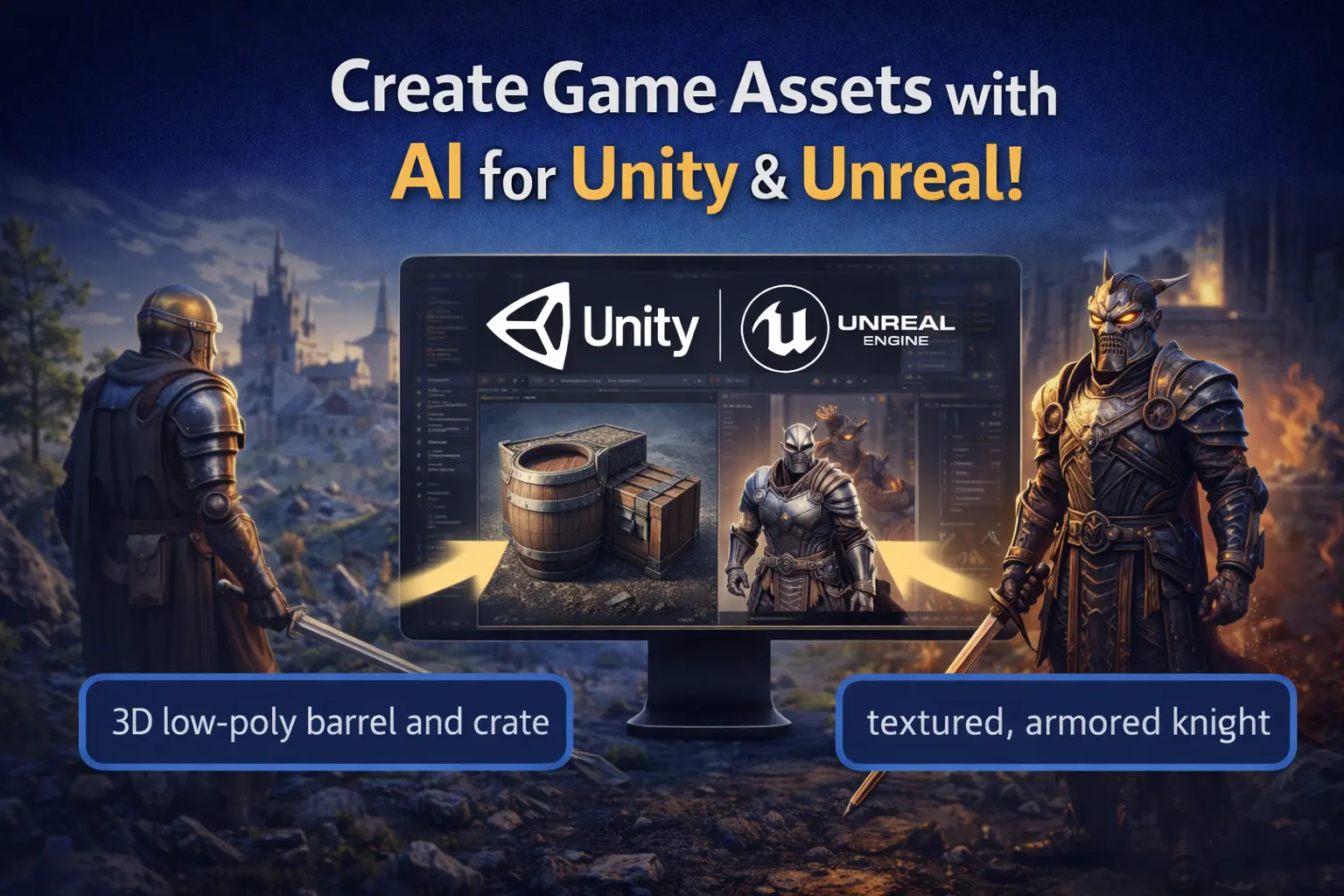
AI in Game Dev: Supercharging Asset Creation, Not Replacing Artists
The intricate world of game development has always demanded a colossal investment of time and resources, particularly when it comes to crafting high-quality visual assets. From sprawling open-world environments to detailed character models and their intricate animations, asset creation is often the bottleneck that dictates production timelines and budgets. Enter Artificial Intelligence, not as a harbinger of job displacement for talented artists, but as a revolutionary co-pilot designed to supercharge creativity and streamline workflows. The discussion around ai generated game assets is no longer theoretical; it's a practical reality that is reshaping how developers approach content creation.
Far from automating artists out of a job, AI is empowering them to achieve more in less time, freeing them from repetitive tasks and allowing them to focus on the truly creative and nuanced aspects of their craft. This paradigm shift means game studios can iterate faster, experiment more boldly, and ultimately deliver richer, more immersive experiences to players.
The Dawn of a New Era: AI's Role in Game Development
For years, the idea of AI generating game assets felt like a distant, futuristic concept. Today, it's an accessible reality, transforming from a speculative marvel into an indispensable tool in the modern game developer's arsenal. AI's core value lies in its ability to automate, accelerate, and assist, fundamentally changing the pace and scope of asset production. It's about providing artists with superpowers, enabling them to tackle ambitious projects with unprecedented efficiency.
Imagine needing dozens of unique props for an environment, or hundreds of animated sprites for a retro-style game. Traditionally, this would involve countless hours of manual labor. With AI, these tasks can be expedited significantly, allowing artists to dedicate their precious time to refining core gameplay assets, perfecting unique character designs, and ensuring overall artistic consistency and vision. AI tools are becoming adept at handling the initial groundwork, generating variations, and performing tedious adjustments, thereby elevating the artist's role from a pure production pipeline to that of a visionary director and refiner.
Revolutionizing Asset Creation: Speed and Versatility
Whether you're crafting pixel-perfect 2D worlds or intricate 3D environments, AI tools offer a diverse range of capabilities that drastically accelerate asset creation. This versatility extends across different art styles and technical requirements, making ai generated game assets a viable solution for nearly any project.
Accelerating 2D Pixel Art Production
For pixel art games, which demand immense attention to detail and consistency across sprites, AI offers transformative solutions:
- Dynamic Character Animations: Gone are the days of manually drawing every frame of a walk cycle. AI generators can create character animations from simple text prompts, skeleton-based controls, or even an automatic character creator. This includes generating essential animations like walking, running, attacking, and custom movements, outputting ready-to-use sprite sheets.
- Immersive Environments & Scenes: Bringing entire scenes to life can be as simple as describing your vision in text. AI can generate animated environments, storytelling sequences, and dynamic backgrounds, perfect for setting the mood and enhancing narrative.
- Effortless Sprite Rotations: Achieving perfect 4 or 8 directional views for isometric or top-down games used to be a tedious chore. AI can generate these rotations with a single click, ensuring consistency and saving hours. You can even upload concept art and a reference sprite to generate consistent directional views that perfectly match your game's established style.
- Maps, Tilesets & Textures: Building game worlds from scratch, especially with detailed tilesets and textures, can be incredibly time-consuming. AI assists in creating these foundational assets for both top-down and side-scrolling games, providing a robust base for level design.
Streamlining 3D Model Generation
For 3D game environments and props, AI integration takes on a different, equally powerful form:
- Parametric Generation for Precision: For assets requiring high precision and easy customization—such as weapons, furniture, or architectural elements—parametric generation tools are invaluable. Artists can start with templates and use intuitive sliders and inputs to adjust every detail. Crucially, these models are generated clean, highly optimized, and often come with Level of Detail (LOD) sliders, giving full control over performance without sacrificing visual quality.
- Generative AI for Organic & Unique Concepts: When you need more organic or uniquely conceptual assets—think strange alien flora, fantasy creatures, or detailed background props—generative AI truly shines. Tools like Text-to-3D and Image-to-3D can transform a simple text prompt or a reference image into a 3D model in under a minute. This is ideal for rapid prototyping and generating base meshes that can then be refined further.
These diverse applications underscore AI's ability to significantly accelerate the production of both 2D and 3D Create Game Assets 10x Faster with AI: Pixel Art & 3D, laying a strong foundation for a more efficient development cycle.
The Hybrid Approach: AI as Your Creative Co-Pilot
The most effective use of AI for game assets isn't as a "one-click final solution," but rather as a powerful assistant within an existing workflow. Think of it as a tool that gets you 80% of the way there in seconds, leaving you more time for customization, optimization, and creative polish. This hybrid approach leverages AI's speed for initial generation and human artistry for critical refinement.
A Practical AI Workflow for Game Assets
Consider the process of creating a set of unique, magical crystals for a cave level in your game:
- Ideation & Base Generation: Instead of sculpting from scratch, jump into a Text-to-3D tool. Prompt variations like "glowing purple soul crystal, low poly, stylized" or "cracked energy crystal on a rock base." Within minutes, you'll have several distinct concepts.
- Selection & Refinement: Pick your favorite generated base model. Many AI tools offer style presets (e.g., "Low Poly," "Fantasy RPG") that generate game-ready models with appropriate polygon counts and texture resolutions, ideal for performance. This initial model might be 80% complete, providing the core form.
- Artistic Polish & Customization: This is where the human artist truly shines. Export the AI-generated base mesh into traditional 3D software like Blender, Maya, or ZBrush. Here, you can sculpt finer details, adjust proportions, add unique damage, paint custom textures, and ensure the asset perfectly aligns with your game's specific aesthetic and narrative.
- Optimization & Integration: While AI can provide optimized starting points, a human artist ensures the final asset is perfectly game-ready. This involves fine-tuning LODs, setting up collision meshes, and integrating the asset seamlessly into game engines like Unity or Unreal.
Ensuring Style Consistency
One of the critical challenges in game asset creation is maintaining visual consistency across thousands of assets. AI tools are surprisingly adept at this. They can adapt to reference images, understanding your original image while making edits. This means perfect style matching when changing clothes on a character, adding accessories, or modifying environments – a crucial feature for any project striving for a cohesive look and feel. Explore strategies for From Text to Game: Crafting Consistent AI-Generated Assets to ensure your game's visual integrity.
Empowering Artists: Beyond Tedium, Towards Innovation
The narrative that AI will replace artists is fundamentally flawed. Instead, AI empowers artists by liberating them from the most tedious and repetitive aspects of their job. By taking over the grunt work, AI allows artists to:
- Focus on Vision and Narrative: Artists can dedicate more time to the overarching creative vision, crafting compelling narratives, designing unique gameplay mechanics, and developing character backstories rather than getting bogged down in repetitive modeling or animation tasks.
- Accelerate Iteration and Prototyping: The ability to rapidly generate concept art and base models means artists can explore more ideas, iterate faster on designs, and prototype new features with unprecedented speed, fostering a more agile development environment.
- Overcome Creative Blocks: AI can act as a creative springboard, offering numerous variations and interpretations of a concept, helping artists break through creative impasses and discover new directions.
- Elevate Skill Sets: With AI handling the routine, artists can focus on mastering advanced techniques in areas like complex material design, lighting, storytelling through environmental art, and pushing the boundaries of artistic expression.
Ultimately, AI allows artists to ascend from simply executing tasks to becoming chief innovators and experience designers, making their contributions even more valuable and impactful.
The integration of AI into game development marks a significant evolutionary step for the industry. Far from being a threat, tools that generate ai generated game assets are proving to be invaluable allies, drastically improving efficiency, fostering creativity, and enabling artists to achieve more ambitious visions than ever before. As AI technology continues to advance, its role will only deepen, cementing its place as an indispensable partner in the ongoing quest to create captivating and immersive digital worlds.